Model Making Guides
Free tutorials, tips, and techniques to help you master the art of model making.
Showing 1-24 of 58 guides

A Basic Guide to Electronics
This guide provides a beginner-friendly introduction to basic electronics, focusing on simple circuits and lighting components. It explains essential concepts such as voltage, current, and resistance, and illustrates how series and parallel circuits function in practical applications. The document also offers guidance on safely connecting MES bulbs and introduces the advantages of modern LEDs. Designed as a straightforward reference, it helps newcomers understand how to build and power small lighting circuits effectively.
 4D
4D

A Guide to LEDs and Resistors
This document explains how to correctly calculate and use resistors when working with LEDs to prevent damage from excessive current. It outlines the formulas needed to determine appropriate resistor values for both parallel and series LED circuits, with worked examples using a 9-volt supply and standard LED specifications. The guide highlights the importance of matching supply voltage, LED forward voltage, and current, and provides practical diagrams to illustrate safe circuit design.
4D

A Guide to Making a Jig
This guide provides step-by-step instructions for creating simple jigs to cut and assemble a scale-model picket fence using card and styrene sheet. It explains how to build both a cutting jig for shaping individual pickets and a gluing jig for aligning and attaching pickets to rails with accuracy and consistency. The document covers safe cutting techniques, precise measurement methods, and recommended materials, enabling modelmakers to produce uniform fence components efficiently and reliably.
4D

A Guide to Mould Making
This guide introduces the fundamental principles of mould making, explaining how to choose appropriate moulding materials based on the master’s shape, the required detail, the intended casting material, budget, and number of reproductions. It outlines when to use release agents and sealants, and emphasises how surface preparation affects the final mould. The document then describes basic open moulds and more complex multi-part rubber moulds, including the use of jackets, keys, clay scrims, and release barriers. It concludes with casting considerations and a brief overview of alternative moulding materials such as alginate, moulding compounds, and polyurethane rubbers.
4D

Adhesives Guide
This guide presents a comprehensive compatibility matrix showing which adhesives work best with a wide range of modelling materials, including plastics, foams, woods, metals, textiles, and composites. By cross-referencing materials against common adhesive types—such as plastic weld, contact adhesive, epoxies, PVA, superglue, Copydex, Gorilla Glue, balsa cement, double-sided tape, spray adhesives, and heat-activation—users can quickly identify suitable bonding options for any combination of materials. Designed as a practical reference for modelmakers, the chart helps ensure strong, safe, and appropriate adhesion choices across diverse project needs.
4D

Alginate Body Casting Compound
This guide provides an overview of alginate, a fast-setting, water-mixed moulding compound widely used for life-casting due to its flexibility and skin safety. It outlines alginate’s advantages, limitations, and short usable lifespan, explaining that it typically yields only one or two casts. The document details preparation, mixing, and application methods, including essential safety considerations for face casting, as well as recommendations for creating supportive plaster jackets. It also includes guidance on suitable casting materials and approximate coverage to assist users in planning moulding projects.
4D

Bespoke Model Trees
This information sheet outlines 4D Modelshop’s bespoke tree-making service, offering custom-built scenic trees tailored to a client’s exact specifications. It highlights the workshop’s ability to match foliage colours, replicate species-specific or stylised forms, and produce trees in a wide range of sizes and finishes, supported by nearly 3,000 configurable options through the Build-a-Tree online tool. The document explains the ordering process, required client information, lead times, and sample production, emphasising close collaboration to ensure accurate, high-quality results for architectural, modelmaking, and scenic projects.
4D

Create a Seafoam Tree
This guide outlines a step-by-step method for creating realistic model trees using twisted wire armatures combined with sea foam foliage. It explains how to form the tree structure by twisting and branching wire, then shaping and texturing the trunk with hot glue and filler before painting. The guide shows how sea foam is applied to represent fine branch structures and how foliage is added using PVA-based textures. A full list of recommended tools and materials is included, making the guide a practical reference for modelmakers seeking naturalistic, custom-sized trees.
4D

Creating Roads and Pavements
This guide explains how to create realistic model roads, pavements, and grassed areas using spray-painting and flocking techniques. It covers essential preparation, safety notes, and spraying methodology, emphasising thin, even coats and rotational spraying for consistent finishes. The document details how to build up road tarmac using layered speckling of beige, white, and black paint, how to achieve natural-looking pavement tones with controlled speckle patterns, and how to apply flock to grass areas using adhesive and masking for clean edges. A full list of recommended tools and materials is included, making the guide a practical reference for achieving professional surface textures in scale models.
4D

Creating Snow Effects
This guide introduces a range of materials and techniques for creating realistic snow effects in scenic modelling. It outlines how to use the Deluxe Scenic Snow Kit—which combines snowflakes, icy sparkles, and Scenic Bond adhesive—to achieve natural snow coverage on urban and rural scenes, trees, grass, and architectural features. The sheet also describes alternative snow products, including NOCH Snow Powder, white flock fibres, and frost/snow-effect spray, explaining their uses, coverage, and application methods. Practical examples demonstrate how these materials can be layered to build convincing winter landscapes for models, dioramas, and props.
4D

Creating Surfaces with Kapa-line Foamboard
This guide explains how to use Kapa-Line foamboard to create highly detailed architectural and scenic surfaces for scale models. It describes how the board’s peelable paper layer reveals a dense, workable polyurethane foam that can be carved, inscribed, textured, or embossed using simple tools. The document covers methods for preparing foamboard panels, bonding them to backing structures, and forming brickwork, stone, wood grain, cobbles, and weathered or damaged surfaces. It also highlights techniques using pencils, scalpels, wire brushes, and pressed objects to achieve varied textures, alongside notes on painting, layering colours, and reinforcing larger constructions. Written by modelmaking author David Neat, the guide provides practical insight into achieving realistic, durable surface finishes with Kapa-Line foam.
4D

Creating Water Effects
This guide provides an overview of the range of materials available for creating realistic water effects in scale modelling, from still ponds and deep pours to waterfalls, rapids, waves and ripples. It explains the properties and uses of various products—including resins, heat-activated compounds, water-effects gels, and clear textured sheets—and outlines their strengths, limitations, and ideal applications. The document also covers supplementary techniques using PVA and heat tools, helping modelmakers choose the most suitable method for producing convincing aquatic surfaces and dynamic water features.
4D

Cutting Balsa
This guide introduces the basic techniques for cutting and shaping balsa wood, a soft, easily worked material widely used in modelmaking. It explains how to cut both balsa sheets and rods cleanly using craft knives, safety rulers, and controlled scoring, with particular attention to managing the natural wood grain to prevent cuts from drifting. The guide also covers simple sanding methods for refining edges and achieving smooth, accurate finishes, making it a practical introduction for beginners working with balsa.
4D

Cutting Card
This guide introduces safe and effective techniques for cutting card in modelmaking. It covers essential tools—cutting mat, metal safety rule, and sharp craft knife—and explains how to set up and protect the work surface. Step-by-step instructions show how to hold the ruler and knife correctly, make controlled, vertical cuts, and work gradually through the material without forcing the blade. Emphasising sharp tools and patience, the guide helps beginners achieve clean, accurate cuts while reducing the risk of accidents.
4D

Cutting Card Elevations
This guide explains how to cut architectural elevations from card accurately and safely for modelmaking. It covers marking out elevations by drawing directly onto card or fixing printed drawings with spray mount, and shows how to position the metal rule so that waste card is removed first, minimising damage if the knife slips. Step-by-step advice on controlled cutting, handling internal corners and window openings, and forming permanent paper-to-card bonds helps users achieve clean, precise façade components while working methodically and safely.
4D

Cutting Finnboard
This guide provides essential instructions for cutting Finnboard, a durable wood-pulp modelling material ideal for sketch models. It outlines the basic tools required and emphasises the importance of using a sharp craft knife for clean, controlled cuts. The guide explains how to position a metal safety rule, maintain a vertical blade angle, and work gradually through the material with multiple passes. By focusing on accuracy, patience, and safe technique, it helps beginners achieve smooth, even cuts when working with Finnboard.
4D

Cutting Finnboard Elevations
This guide outlines the correct method for cutting architectural elevations from Finnboard, a dense wood-pulp modelling material. It explains how to prepare and attach printed elevations with spray adhesive, position the metal rule to protect key areas, and make controlled, vertical knife passes for clean edges. Special attention is given to cutting out windows and internal corners, including techniques for releasing corners without damaging the façade. The guide helps beginners produce accurate, precisely cut Finnboard elevation components for sketch and presentation models.
4D

Cutting Foamboard
This guide introduces the fundamentals of cutting and joining foamboard for modelmaking. It explains the structure of foamboard, emphasises the need for a sharp blade to avoid ragged edges, and outlines the correct cutting technique using a metal safety rule and steady, vertical knife passes. The guide also describes how to create clean right-angle joints by removing the top card layer and foam core while leaving the bottom layer intact. These methods help beginners achieve neat, accurate cuts and professional-looking foamboard assemblies.
4D

Cutting Foamboard Elevations
This guide explains how to cut architectural elevations from foamboard cleanly and accurately for modelmaking. It covers attaching printed elevations with spray adhesive, positioning the metal rule to protect key areas, and using controlled, vertical knife passes to avoid tearing the foam core. Techniques for cutting out windows and releasing tight corners are included, helping beginners produce precise, professional-looking façade components from foamboard.
4D

Cutting Styrofoam
This guide introduces the basic techniques for cutting and shaping Styrofoam for modelmaking. It explains how to score and snap the material for clean straight cuts, or cut fully through using a long, vertical blade. The guide also covers tidying edges with sanding to achieve smooth finishes. Emphasising control, patience, and simple hand tools, it helps beginners work safely and effectively with Styrofoam as a lightweight, versatile construction material.
4D

Desktop Modelling
This guide introduces the essential techniques for creating desktop architectural models using card and foamboard. It covers setting out elevations, cutting clean and accurate components, and applying printed details with spray mount. Clear instructions explain how to glue card edges using PVA, form strong foamboard joints with UHU contact adhesive, and produce neater corner connections by removing the foam core. The guide also outlines how to cut and apply fine card details such as window frames and stonework, helping modelmakers build crisp, well-finished miniature structures.
4D
Dry Transfer Service
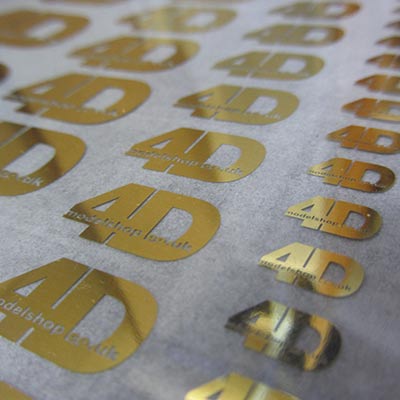
This information sheet outlines 4D Modelshop’s bespoke dry transfer production service, offering single-colour, multi-colour, and metallic finishes with high or low tack adhesives. It explains how to prepare and supply artwork, including colour references and separation requirements, and describes the approval process for artwork created in-house. The guide also details pricing considerations and typical applications—from product design and branding to architectural model detailing and hobby modelling—highlighting the service’s flexibility and precision.
4D

Finnboard Modelling
This product information sheet introduces Finnboard, a strong, versatile, and sustainable modelling material made from unbleached wood-pulp offcuts from the Finnish timber industry. It outlines Finnboard’s key properties—its high strength, stability, smooth surface, acid-free composition, and ability to be laser-cut, glued, curved, and painted. The guide explains how to process Finnboard using standard modelmaking tools, form it into curves by dampening, and select from the available thicknesses and sheet sizes. Widely favoured in architectural modelmaking, Finnboard offers an eco-friendly alternative to traditional greyboard.
4D

Foamboard Modelling
This guide introduces the core techniques for designing and constructing simple architectural models using foamboard. It explains how to set out elevations, attach printed drawings with spray mount, and cut clean, accurate components by making controlled vertical scalpel passes. Instructions are provided for forming strong, neat joints using UHU as a contact adhesive, including a method for concealing joints by removing only part of the foamboard thickness. The guide offers practical, beginner-friendly steps for assembling durable, tidy foamboard models.
4D
Have knowledge to share?
Submit a guide or tutorial to help others learn model making techniques.
Submit a GuideLearn how to contribute to the directory.